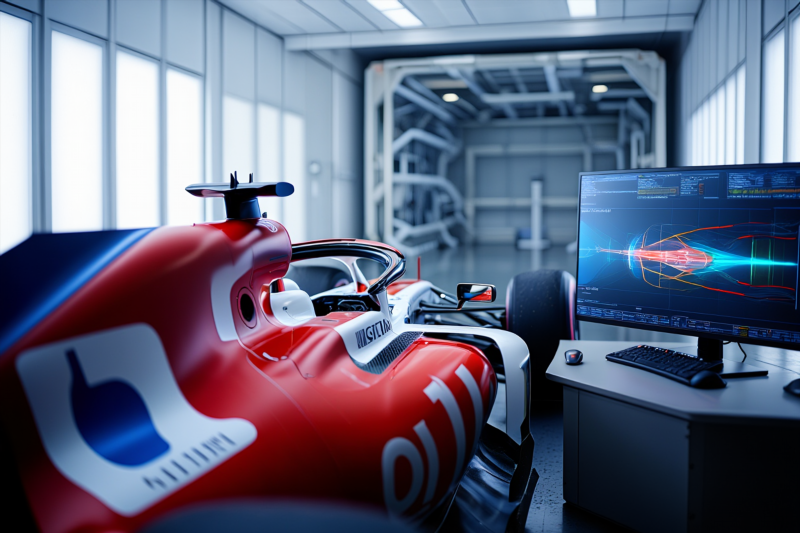
In the high-stakes world of Formula 1, teams constantly seek ways to optimize aerodynamic performance while managing costs effectively. Two primary methods dominate the aerodynamic development process: Wind Tunnel Testing and Computational Fluid Dynamics (CFD). Both play a crucial role in refining car designs, but understanding their differences, advantages, and how to strategically combine them can significantly reduce expenses without compromising performance. This article explores how teams can leverage these tools to enhance their design process while cutting aero development costs.
Understanding Wind Tunnel Testing and CFD
What Is Wind Tunnel Testing?
Wind tunnel testing involves physically simulating airflow over scaled or full-sized models of race cars within a controlled environment. It provides real-world aerodynamic data, allowing engineers to observe complex flow patterns, identify drag sources, and validate design modifications.
Pros:
- Immediate physical feedback
- Realistic airflow conditions
- Proven track record in F1 for decades
Cons:
- High operational costs (facility maintenance, model construction)
- Time-consuming setup and testing cycles
- Limitations in iteration speed
What Is Computational Fluid Dynamics (CFD)?
CFD uses computer simulations to model airflow over and around vehicle geometries. Advanced algorithms solve the Navier-Stokes equations to predict aerodynamic forces and flow behaviors virtually.
Pros:
- Cost-effective for numerous iterations
- Faster turnaround times
- Easy to modify and explore different design ideas
Cons:
- Requires significant computing resources
- Dependent on simulation accuracy and boundary conditions
- May struggle to replicate complex turbulent flows perfectly
Strategic Cost-Effective Use of Aero Development Tools
Combining Wind Tunnel and CFD for Optimal Results
Most successful F1 teams use a hybrid approach, leveraging the strengths of both methods:
| Aspect | Wind Tunnel Testing | CFD |
| Cost | High | Lower |
| Speed | Slower | Faster |
| Practicality | Physical validation | Virtual exploration |
| Data reliability | High | Dependent on model quality |
Best Practice: Use CFD for initial design iterations and concept exploration, then validate promising ideas in the wind tunnel before final implementation. This reduces reliance on extensive physical testing, thereby lowering costs.
When Should You Prioritize Cost Savings?
- Early-Stage Design: Rely on CFD to explore multiple aerodynamic concepts rapidly.
- Validation Phases: Use wind tunnel testing selectively for critical validation points to ensure data accuracy.
- Regulatory Compliance: Always validate CFD results with physical testing to meet FIA standards.
Streamlining the Workflow: Tips for Cost-Effective Aero Development
- Invest in High-Quality CFD Software and Computing Infrastructure: This minimizes the number of physical tests needed.
- Develop Accurate CAD Models: Precise digital models reduce errors in simulations and wind tunnel models.
- Implement Data-Driven Iteration Cycles: Use CFD data to inform design tweaks quickly.
- Schedule Targeted Wind Tunnel Sessions: Reserve physical testing for validation of the most promising design changes.
- Leverage Data Sharing and Collaboration: Ensure cross-team communication to prevent redundant testing and simulations.
Advanced Strategies for Cost Reduction
Use of AI and Machine Learning
Integrate AI algorithms to predict aerodynamic performance based on existing CFD data, reducing the need for extensive simulations and physical tests.
Modular Design and Testing
Adopt a modular approach to components, enabling targeted testing and simulation, thus minimizing overall testing volume.
Digital Twins and Virtual Prototyping
Create comprehensive virtual models that simulate entire aerodynamic behaviors, streamlining the development process further.
Frequently Asked Questions
Can CFD replace wind tunnel testing entirely?
While CFD has advanced considerably, it cannot wholly replace wind tunnel validation, especially for high-fidelity measurements and regulatory compliance. Combining both remains the best practice for cost-effective, accurate aerodynamics development.
How can smaller teams benefit from these technologies?
Smaller teams can optimize costs by focusing on CFD for initial design exploration and limited wind tunnel validation. Cloud-based CFD solutions and partnerships with testing facilities can also reduce upfront investments.
What are the risks of over-relying on CFD?
Over-reliance on CFD without proper validation may lead to inaccuracies, as simulated airflow doesn’t perfectly replicate real-world conditions. A balanced hybrid approach mitigates this risk.
Balancing wind tunnel testing and CFD is key to cutting aero development expenses in Formula 1. By strategically combining these methods—using CFD for rapid iteration and wind tunnels for validation—teams can significantly reduce costs while maintaining, or even enhancing, aerodynamic performance. Embracing innovative tools like AI, digital twins, and modular testing further streamlines the process, ensuring that aerodynamic breakthroughs remain within budget. Remember, the goal is not just speed on the track but efficiency in development.
Take Action Now: Evaluate your current aerodynamic development pipeline. Invest in robust CFD solutions, plan targeted wind tunnel validations, and explore hybrid strategies to optimize costs and unlock new performance levels.
*For more strategies and deep analysis on F1 technology and engineering breakthroughs, stay tuned to ApexHappiness F1 — where science meets speed.*